Spermidine-autophagy-longevity-benefits
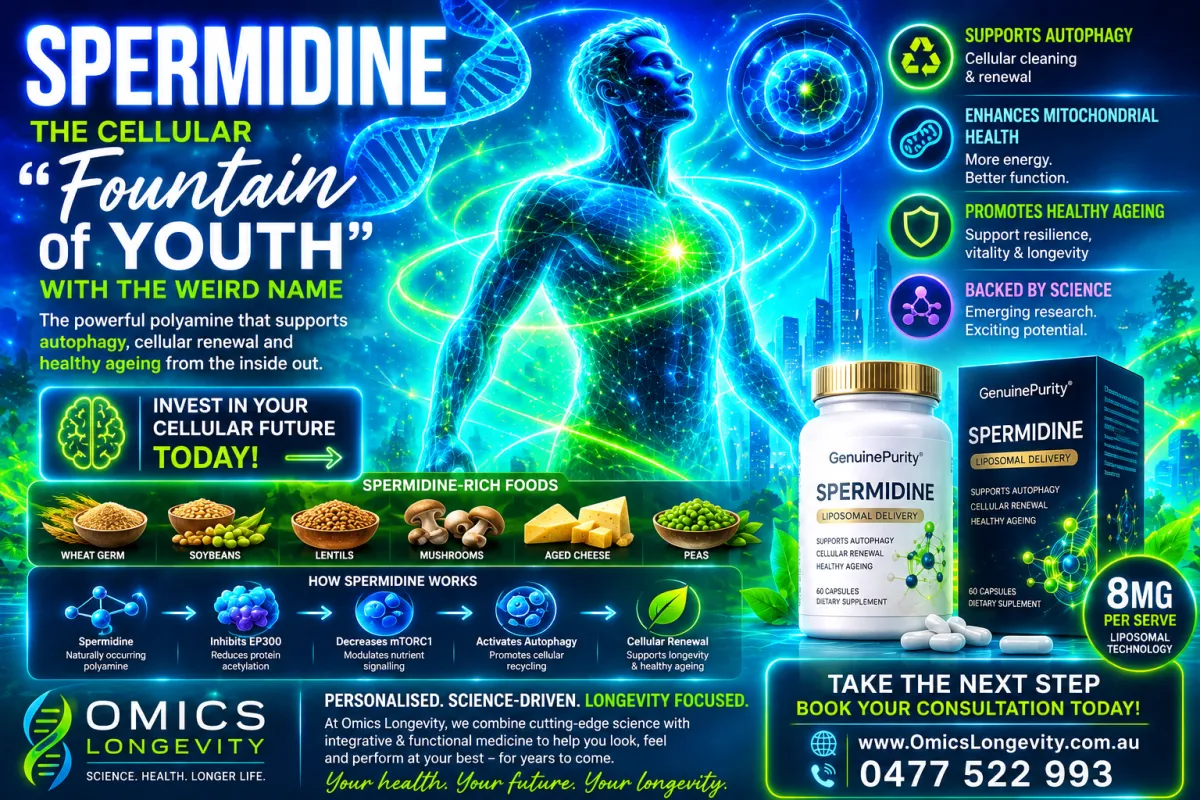
Spermidine: The Cellular “Fountain of Youth” With the Weird Name
Few longevity compounds have a name quite as memorable—or as awkward—as spermidine. Yet behind the unusual name is a naturally occurring polyamine that has become an intriguing focus of ageing and autophagy research.
Spermidine is produced within the human body and is also found naturally in foods such as wheat germ, soybeans, legumes, mushrooms, whole grains and aged cheeses. It participates in fundamental cellular processes involving growth, protein synthesis, mitochondrial function and cellular recycling.
What makes spermidine particularly interesting to longevity researchers is its relationship with autophagy—the cell's internal recycling and quality-control system.
Experimental research suggests that spermidine can influence EP300 acetyltransferase activity, protein acetylation and mTORC1 signalling, creating cellular conditions favourable to autophagy.

Important: “Fountain of youth” is a metaphor, not a medical claim. Spermidine has produced compelling results in laboratory and animal research, but it has not been proven to reverse human ageing or extend human lifespan.
What Is Spermidine?
Spermidine belongs to a family of naturally occurring molecules called polyamines. Despite its strange name, it isn't some exotic synthetic anti-ageing chemical.
Polyamines are present throughout living organisms and are involved in processes including:
cellular growth and renewal
DNA and RNA function
protein synthesis
mitochondrial homeostasis
cellular stress responses
autophagy
Interest in spermidine accelerated when researchers discovered that increasing spermidine availability could extend lifespan in several experimental organisms.
Observational human research is also interesting. In a prospective study involving 829 adults, higher dietary spermidine intake was associated with lower all-cause mortality over long-term follow-up. However, an observational association cannot establish that spermidine itself caused the reduction in mortality.
Spermidine and Autophagy: Cellular Housekeeping
One of the most important proposed longevity mechanisms of spermidine is autophagy.
The word literally means “self-eating,” but a better description is cellular recycling.
Throughout life, cells accumulate dysfunctional proteins, damaged organelles and other cellular material. Autophagy helps identify and package some of this material into structures called autophagosomes.
These eventually interact with lysosomes, where the contents can be broken down and their components recycled.
The basic pathway
Spermidine → pro-autophagy signalling → autophagosome formation → lysosomal degradation → recycling of cellular components
This mechanism is important because declining cellular quality control is one of the biological processes associated with ageing.
Educational Figure: Spermidine–Autophagy Pathway
The pathway above illustrates how spermidine-associated signalling can influence autophagy-related proteins, autophagosome formation and lysosomal recycling.
The EP300–Protein Acetylation Pathway
This is where the molecular biology becomes particularly interesting.
One important target identified in spermidine research is EP300 (p300).
EP300 is a lysine acetyltransferase. In simplified terms, acetyltransferases transfer acetyl groups onto proteins and thereby alter their activity.
EP300 can acetylate several proteins involved in autophagy, including ATG5, ATG7, ATG12 and LC3. Experimental research indicates that this activity can function as a brake on autophagy.
Spermidine appears to interfere with that brake.
In laboratory experiments, spermidine inhibited recombinant human EP300 acetyltransferase activity. Increasing acetyl-CoA concentrations attenuated this effect, supporting a competitive mechanism involving acetyl-CoA-dependent EP300 activity.
A simplified model looks like this:
SPERMIDINE
↓
EP300 acetyltransferase activity ↓
↓
Acetylation of autophagy-related proteins ↓
↓
Autophagy machinery becomes more permissive
↓
Autophagic flux ↑
↓
Damaged cellular components recycled
The same experimental work found that spermidine-induced changes were accompanied by mTORC1 inhibition, providing another potentially important connection between spermidine and cellular nutrient-sensing pathways.
Educational Figure: Spermidine → EP300 → Protein Acetylation → Autophagy
Think of EP300 as one of several molecular brakes on autophagy. Experimental evidence suggests spermidine can partially release this brake by influencing EP300-mediated acetylation.
Spermidine and mTORC1 Signalling
mTORC1—mechanistic target of rapamycin complex 1—is one of the body's major nutrient-sensing pathways.
When nutrients, amino acids and growth signals are plentiful, mTORC1 generally promotes cellular growth and protein synthesis.
When nutrient availability falls, cells can shift away from growth and toward maintenance and recycling.
That includes increased autophagy.
The relationship can therefore be simplified as:
High mTORC1 activity
→ growth and protein synthesis
→ autophagy tends to be suppressed
Reduced mTORC1 activity
→ less growth signalling
→ conditions become more favourable for autophagy
Importantly, spermidine shouldn't simply be described as a “natural mTOR inhibitor.” Its biology is more complicated than that. But experimental studies have found spermidine-induced autophagic flux occurring alongside reduced mTORC1 signalling.
Spermidine's longevity pathway at a glance
SPERMIDINE
↓
EP300 activity ↓
↓
Protein acetylation changes
↓
ATG5 • ATG7 • ATG12 • LC3 regulation
↓
mTORC1 signalling may decrease
↓
Autophagy ↑
↓
Autophagosome formation
↓
Lysosomal degradation
↓
CELLULAR RECYCLING & QUALITY CONTROL
This is one reason spermidine is often discussed alongside other calorie-restriction mimetic and pro-autophagy strategies in longevity medicine.
Spermidine and Mitochondrial Quality Control
Mitochondria generate much of the usable energy required by our cells.
But mitochondria themselves can become damaged.
A healthy cell therefore needs mechanisms to maintain mitochondrial quality rather than simply producing more mitochondria.
Autophagy—and its mitochondria-specific counterpart, mitophagy—forms part of this quality-control network.
By promoting cellular recycling pathways in experimental models, spermidine may therefore indirectly contribute to maintaining a healthier population of cellular components, including mitochondria.
This has generated research interest in spermidine for metabolic, cardiovascular, neurological and healthy-ageing applications, but many proposed benefits still rely heavily on preclinical evidence.
Spermidine and Cardiovascular Ageing
Cardiovascular research has produced some of the most interesting preclinical spermidine findings.
Experimental studies have reported effects involving autophagy, oxidative stress, mitochondrial function and cardiac physiology.
Meanwhile, the prospective human cohort mentioned earlier found that people consuming more dietary spermidine had lower mortality rates.
However, this does not prove that taking a spermidine supplement prevents cardiovascular disease or extends lifespan.
People eating spermidine-rich diets may also consume more whole grains, legumes, vegetables and other beneficial foods, making cause and effect difficult to separate.
What About Brain Health and Memory?
Spermidine has attracted substantial interest in neuroscience because autophagy and mitochondrial quality control are relevant to the ageing brain.
But this is also a good example of why longevity research needs to be interpreted carefully.
The SmartAge randomized clinical trial investigated a spermidine-rich wheat-germ extract in 100 adults aged 60–90 with subjective cognitive decline.
Participants received approximately 0.9 mg additional spermidine per day for 12 months.
The trial did not find a significant improvement in its primary memory outcome compared with placebo. Exploratory findings involving verbal memory and inflammation were considered hypothesis-generating and require confirmation.
That distinction matters.
Spermidine is scientifically fascinating, but fascinating biology is not the same thing as proven clinical anti-ageing therapy.
Which Foods Are Rich in Spermidine?
One of the best things about spermidine is that supplementation isn't the only way to obtain it.
It occurs naturally in many nutritious foods.
Spermidine-rich foods include
FoodSpermidine potentialWheat germ⭐⭐⭐⭐⭐ Very highSoybeans⭐⭐⭐⭐⭐Tempeh / fermented soy⭐⭐⭐⭐Mushrooms⭐⭐⭐⭐Peas⭐⭐⭐⭐Lentils⭐⭐⭐Chickpeas⭐⭐⭐Aged cheeses⭐⭐⭐Broccoli⭐⭐⭐Cauliflower⭐⭐⭐Whole grains⭐⭐⭐Brown rice⭐⭐Oats⭐⭐Spinach and cabbage⭐⭐Mango and citrus fruit⭐⭐
Wheat germ, soy products, legumes, mushrooms, whole grains and aged cheeses are repeatedly identified among useful dietary sources.
A Mediterranean-style or predominantly whole-food diet can therefore provide spermidine naturally while simultaneously delivering fibre, polyphenols, minerals and other beneficial nutrients.
Food First—or Spermidine Supplement?
A food-first strategy has obvious advantages.
Increasing wheat germ, legumes, mushrooms, vegetables and appropriate fermented foods doesn't just increase spermidine intake—it improves the overall nutritional density of the diet.
However, some people interested in longevity medicine choose a standardized supplement because it provides a more consistent quantity than diet alone.
One commercially available example is Genuine Purity Liposomal Spermidine.
Genuine Purity Liposomal Spermidine
According to the manufacturer's current product information, Genuine Purity Liposomal Spermidine uses liposomal encapsulation and is marketed as a cellular-renewal/autophagy-support supplement. The company's spermidine-specific information describes its product as naturally sourced and currently advertises an 8 mg daily serving.
The images above show the Genuine Purity Spermidine product packaging.
It is important to separate manufacturer claims from established clinical evidence. In particular, evidence from one spermidine formulation or dose should not automatically be assumed to demonstrate equivalent clinical outcomes from another product.
Is More Spermidine Always Better?
No.
Longevity biology rarely follows the rule that “more is better.”
Spermidine participates in fundamental processes involving cellular proliferation, protein translation, metabolism and autophagy. The optimal amount may depend on diet, age, medical history, medications and the reason it is being considered.
The fact that a compound occurs naturally in food does not mean unlimited supplemental quantities are necessarily beneficial.
This is particularly relevant for people with significant medical conditions, people receiving cancer treatment, pregnant or breastfeeding patients, or people taking multiple medications or supplements.
Why Medical Supervision Matters
Longevity medicine should be more sophisticated than simply assembling a large collection of supplements.
A qualified integrative and functional medicine doctor can consider spermidine in the context of the individual's overall health, medications, diet, metabolic status, laboratory findings and other longevity interventions.
This becomes particularly important when spermidine is being combined with interventions that may influence overlapping pathways such as:
AMPK • mTOR • autophagy • NAD⁺ metabolism • sirtuins • mitochondrial biogenesis • insulin signalling • cellular senescence
The aim should not be to indiscriminately stimulate or suppress one pathway.
Healthy physiology depends on balance, timing and metabolic flexibility.
Spermidine: Fountain of Youth or Fascinating Longevity Molecule?
Probably the latter—for now.
The experimental science surrounding spermidine is genuinely interesting.
Its ability to influence EP300-mediated protein acetylation and autophagy, together with its relationships to mTORC1, cellular recycling and mitochondrial quality control, provides a plausible biological framework for many of the healthy-ageing effects observed in laboratory models.
Human evidence, however, remains much less definitive.
Observational research has linked higher dietary spermidine intake with lower mortality, but observational studies cannot establish causation. And the 12-month SmartAge randomized trial did not demonstrate a significant improvement in its primary cognitive endpoint.
So spermidine shouldn't be sold as a magic anti-ageing pill.
It is better viewed as a promising component of the rapidly developing science of autophagy, cellular maintenance and healthy ageing.
The Spermidine Longevity Pathway
A simplified educational summary
Spermidine
↓
EP300 acetyltransferase inhibition
↓
Reduced acetylation of selected autophagy proteins
↓
ATG5 / ATG7 / ATG12 / LC3 activity becomes more permissive
↓
mTORC1/autophagy signalling shifts
↓
Autophagosome formation ↑
↓
Lysosomal degradation & recycling ↑
↓
Cellular quality control
↓
Potential support for healthier ageing

Interested in Spermidine and Longevity Medicine?
At Omics Longevity, longevity strategies can be considered as part of a broader, medically supervised approach incorporating nutrition, metabolic health, mitochondrial function, autophagy and other biological pathways associated with ageing.
Rather than focusing on a single “anti-ageing” supplement, the goal is to understand how different interventions fit within an individual's broader health picture.
Omics Longevity
Integrative & Functional Medicine | Healthy Ageing | Longevity Medicine
www.OmicsLongevity.com.au
Phone: 0477 522 993
Speak with a qualified integrative and functional medicine doctor before commencing spermidine or a broader longevity supplement program, particularly if you have an existing medical condition or take prescription medication.
This article is for educational purposes only and does not constitute medical advice. Spermidine supplements are not proven treatments for ageing or age-related disease, and preclinical longevity findings should not be interpreted as evidence that supplementation extends human lifespan.