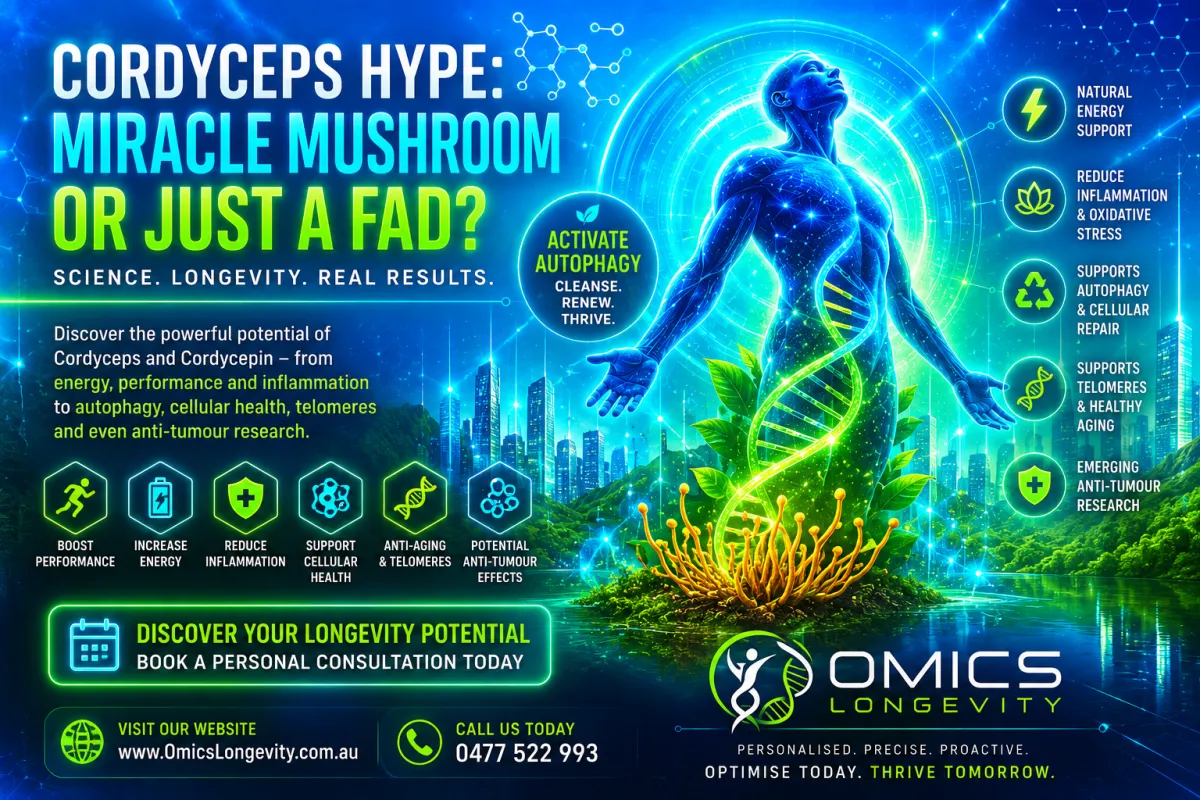
Cordyceps Benefits: Miracle Mushroom, Cordycepin & Longevity Science
Cordyceps Hype: Miracle Mushroom or Just a Fad?
Cordyceps benefits, cordycepin benefits, Cordyceps longevity, Cordyceps exercise performance, cordycepin autophagy, Cordyceps anti-aging, cordycepin cancer research

Cordyceps has gone from an unusual fungus used in traditional Asian medicine to one of the most talked-about ingredients in the modern longevity and performance-supplement world.
It is promoted for energy, endurance, immune support, inflammation, healthy ageing and even anti-tumour activity. But there's an important distinction that often gets lost in the marketing:
Cordyceps and cordycepin are not the same thing.
And while there is intriguing science—particularly around AMPK, mTOR, autophagy, inflammation and cellular senescence—many of the most exciting longevity and cancer findings remain preclinical.
So, is Cordyceps a miracle mushroom, or simply another wellness fad?
The answer lies somewhere in between.
What Is Cordyceps?
Cordyceps refers to a group of fungi with a long history of traditional medicinal use. Two names commonly encountered are Ophiocordyceps sinensis (historically called Cordyceps sinensis) and Cordyceps militaris.
Modern supplements generally contain cultivated fungal material or extracts rather than wild Cordyceps.
These fungi contain numerous potentially bioactive substances, including:
polysaccharides
nucleosides
sterols
peptides and amino acids
phenolic compounds
cordycepin
That final compound has become particularly interesting to longevity and biomedical researchers.
Cordyceps vs Cordycepin: What's the Difference?
This distinction is essential.
Cordyceps is the fungus or fungal preparation. Cordycepin is an individual bioactive molecule found in certain Cordyceps species.
Cordycepin is also known as 3′-deoxyadenosine. Structurally, it resembles the naturally occurring nucleoside adenosine but lacks a hydroxyl group at the 3′ position of its ribose sugar.
That apparently small chemical difference can substantially alter its biological behaviour.
Research has linked cordycepin with effects involving:
AMPK activation → mTOR modulation → autophagy regulation → cellular stress responses
as well as effects on pathways including:
PI3K/AKT/mTOR, MAPK/ERK, apoptosis, cell-cycle regulation and inflammatory signalling.
A systematic review of cordycepin research found relatively consistent reductions in PI3K/mTOR/AKT and ERK signalling together with activation of AMPK across experimental studies.
EDUCATIONAL INFOGRAPHIC: Cordyceps vs Cordycepin
CORDYCEPS 🍄 | CORDYCEPIN 🧬 |
|---|---|
Whole fungus/extract | Specific bioactive molecule |
Contains multiple compounds | 3′-deoxyadenosine |
Polysaccharides + nucleosides + other constituents | Adenosine analogue |
Traditionally used for vitality | Studied mechanistically in cells and animals |
Human supplement research exists | Much research remains preclinical |
Composition varies considerably | More precisely defined molecule |
This distinction also explains why research performed using purified cordycepin cannot automatically be extrapolated to every commercial Cordyceps supplement.
1. Could Cordyceps Improve Exercise Performance?
This is probably Cordyceps' best-known modern claim.
The theory is that Cordyceps may influence cellular energy metabolism and oxygen utilisation, potentially improving aerobic exercise capacity.
A 2025 systematic review and meta-analysis of fungal supplementation in athletes reported improvements associated with Cordyceps sinensis supplementation in measures including endurance performance, ventilatory threshold and VO₂peak. However, the overall literature remains relatively small and heterogeneous, meaning Cordyceps should not be considered a guaranteed performance enhancer.
ENERGY PATHWAY INFOGRAPHIC
Cordyceps / Cordycepin
↓
Cellular metabolic signalling
↓
⚡ AMPK
↓
Energy homeostasis + mitochondrial metabolism
↓
Potential improvement in cellular energy efficiency
↓
🏃 Possible endurance and exercise benefits
The key word remains possible. Exercise training, adequate sleep, nutrition and recovery have dramatically stronger evidence behind them.
2. Cordycepin and AMPK: The Cellular Energy Sensor
One of the most intriguing mechanisms associated with cordycepin is AMP-activated protein kinase (AMPK).
AMPK functions as one of the body's major cellular energy sensors.
When cellular energy availability falls, AMPK can shift metabolism away from energy-intensive growth processes and toward pathways that help restore energy balance.
Experimental evidence indicates that cordycepin can activate AMPK while influencing downstream mTOR signalling.
This becomes especially interesting in longevity research because AMPK is intimately connected with another major process:
autophagy.
3. Cordycepin and Autophagy: Cellular Housekeeping
Autophagy literally means "self-eating."
But rather than being destructive, appropriate autophagy is an essential cellular recycling system.
Cells continually accumulate:
damaged proteins
dysfunctional cellular components
damaged mitochondria
metabolic waste.
Autophagy helps package and recycle some of this material.
CELLULAR CLEAN-UP INFOGRAPHIC
Damaged cellular material
⬇
🗑️ Autophagosome formation
⬇
♻️ Lysosomal breakdown
⬇
Recycled cellular components
⬇
⚡ Improved cellular housekeeping
Cordycepin has attracted particular attention because laboratory research suggests that it can influence autophagic signalling.
One cell study found that cordycepin improved lysosomal function and restored impaired autophagy through signalling involving AMPK and mTOR-p70S6K, while reducing markers of cellular senescence in a stress-induced premature senescence model.
A review of cordycepin and autophagy similarly identified autophagic regulation as one of the potentially important mechanisms underlying its health-promoting and anti-cancer effects.
That does not, however, demonstrate that taking a Cordyceps capsule increases human lifespan.
4. Could Cordyceps Reduce Inflammation?
Chronic low-grade inflammation—sometimes called "inflammaging"—is increasingly studied as one component of biological ageing.
Cordycepin has demonstrated anti-inflammatory activity in experimental systems.
A systematic review examining hundreds of cordycepin studies found relatively consistent evidence of suppressed cellular inflammatory responses, although much of this evidence came from laboratory and animal models rather than large human clinical trials.
INFLAMMATION & AGEING INFOGRAPHIC
🔥 Chronic inflammatory signalling
↓
Oxidative stress
↓
Mitochondrial dysfunction
↓
DNA and cellular damage
↓
Cellular senescence
↓
More inflammatory signalling
Potential intervention point:
🍄 Cordyceps-derived compounds → inflammatory signalling / AMPK / cellular stress pathways
This is an interesting biological model—but it should not be interpreted as proof that Cordyceps prevents age-related disease.
5. Cordycepin and Mitochondrial Health
Mitochondria are the energy-producing structures inside our cells.
As we age, mitochondrial efficiency can decline, while damaged mitochondria may accumulate.
This is one reason mitochondrial health has become a major focus of longevity medicine.
Cordycepin's interactions with AMPK, mTOR and autophagic pathways provide a plausible mechanistic connection between the compound and cellular energy homeostasis. Experimental studies also suggest effects on mitochondrial function in specific cellular models.
LONGEVITY PATHWAY MAP
Cordycepin
↙️ ↓ ↘️
AMPK ↑ | mTOR signalling ↔ | Inflammatory pathways ↓
↓
Autophagy / lysosomal function
↓
♻️ Cellular recycling
↓
⚡ Mitochondrial quality & metabolic homeostasis
↓
🧬 Potential healthy-ageing effects
Importantly, arrows on a molecular pathway diagram are not equivalent to proven clinical outcomes in humans.
6. Cordycepin and Cellular Senescence
Cellular senescence occurs when damaged or stressed cells stop dividing but remain metabolically active.
Accumulation of senescent cells is considered one of the biological hallmarks associated with ageing.
Some senescent cells can produce inflammatory signalling molecules collectively known as the senescence-associated secretory phenotype (SASP).
Cordycepin has shown intriguing anti-senescence activity experimentally.
In a 2021 cell study, cordycepin improved lysosomal function and autophagy and inhibited stress-induced cellular senescence through AMPK/mTOR-p70S6K-related signalling.
This makes cordycepin interesting to longevity researchers, but it is premature to label it a clinically established senolytic or anti-ageing drug.
7. What About Cordyceps, Cordycepin and Telomeres?
This is where marketing claims require particular caution.
Telomeres are protective structures at the ends of chromosomes.


They tend to become shorter during repeated cellular division, and telomere biology is closely linked to cellular senescence and ageing.
There are intriguing laboratory findings involving cordycepin.
For example, research in human mesenchymal stem-cell cultures reported differences in SIRT1 expression, telomerase activity and relative telomere length at some experimental passages following cordycepin exposure.
Separate cellular research involving a genetic telomere disorder has also shown that cordycepin can affect RNA processing associated with telomerase biology.
But here's the crucial point:
There is currently no strong clinical evidence showing that taking Cordyceps or cordycepin supplements preserves or lengthens telomeres in healthy humans.
So claims such as "Cordyceps lengthens your telomeres" go considerably beyond the available evidence.
The cellular findings are fascinating, but they remain primarily hypothesis-generating.
8. Could Cordyceps or Cordycepin Fight Tumours?
This is one of the most exciting—and most easily exaggerated—areas of Cordyceps research.
Cordycepin has demonstrated anti-tumour effects across numerous experimental cancer models.
A systematic review reported reduced tumour growth across multiple animal studies, while mechanistic research has implicated pathways including:
PI3K/AKT/mTOR
AMPK
MAPK/ERK
apoptosis
cell-cycle arrest
autophagy
tumour-cell migration
inflammatory signalling.
A 2024 review similarly described potential antitumour mechanisms involving autophagy and inhibition of signalling pathways such as MAPK/ERK, while stressing the ongoing need for clinical translation.
ANTI-TUMOUR RESEARCH PATHWAY
CORDYCEPIN
⬇
⚡ AMPK activation
⬇
PI3K → AKT → mTOR modulation
PLUS
MAPK / ERK signalling ↓
⬇
Cell proliferation ↓
Autophagy modulation
⬇
Cellular stress/apoptosis in some models
Migration & invasion ↓
⬇
🔬 Potential anti-tumour activity
There is an important complication: autophagy has a dual role in cancer. In some circumstances it can suppress tumour development; in established cancers, tumour cells can sometimes exploit autophagy to survive metabolic stress.
This is one reason self-prescribing compounds intended to manipulate autophagy during cancer treatment is not advisable.
Cordyceps and cordycepin should not be considered replacements for established cancer therapies.
9. Could Cordyceps Really Have Anti-Ageing Effects?
Possibly—but "anti-ageing" needs to be defined carefully.
Animal research has previously reported effects of Cordyceps extracts on antioxidant enzymes and markers of oxidative damage.
Cordycepin has additionally demonstrated potentially relevant actions involving:
AMPK activation + autophagy + lysosomal function + cellular senescence + SIRT1 + mitochondrial biology + inflammation
Together, these mechanisms make Cordyceps and particularly cordycepin scientifically interesting in longevity research.
But there is a major difference between:
affecting an ageing-associated pathway
and
proving that a substance slows human biological ageing or extends lifespan.
At present, the second claim has not been established.
10. Why Supplement Quality Matters
Another problem with the Cordyceps market is that "Cordyceps" on a label doesn't tell you everything you need to know.
Products may differ substantially in:
fungal species
fruiting body versus mycelium
cultivation method
extraction method
polysaccharide concentration
beta-glucan content
cordycepin concentration
contaminants
independent testing.
And remember:
More Cordyceps does not necessarily mean more cordycepin.
Different species and cultivation conditions can produce dramatically different phytochemical profiles.
For someone specifically interested in the experimental science surrounding cordycepin, the actual cordycepin content of a product is therefore much more relevant than simply seeing the word "Cordyceps" on the front of the bottle.
Cordyceps vs Cordycepin: The Longevity Snapshot
Potential Effect | Cordyceps | Cordycepin | Evidence |
|---|---|---|---|
Exercise/endurance | ✅ | Possible | Emerging human evidence |
Energy metabolism | ✅ | ✅ | Mechanistic + limited clinical |
AMPK activation | Possible | ✅ | Mainly preclinical |
Autophagy | Possible | ✅ | Mainly cell/animal |
Anti-inflammatory activity | ✅ | ✅ | Preclinical + some human context |
Cellular senescence | Emerging | ✅ | Preclinical |
Mitochondrial health | Possible | Emerging | Mostly mechanistic |
Telomere biology | Uncertain | 🔬 Emerging | Cell studies; not clinically proven |
Anti-tumour effects | 🔬 | 🔬🔬 | Strong preclinical interest; insufficient clinical proof |
Human lifespan extension | ❌ Unproven | ❌ Unproven | No convincing evidence |
Miracle Mushroom or Just a Fad?
The most scientifically defensible answer is:
Neither.
Cordyceps isn't a miracle mushroom, and the evidence doesn't justify many of the dramatic claims circulating online.
But calling it merely a fad also overlooks an interesting body of research.
Cordycepin in particular interacts with several pathways that are highly relevant to modern metabolic and longevity research, including:
AMPK → mTOR → autophagy
as well as PI3K/AKT, ERK, lysosomal function, inflammation, cellular senescence and potentially telomere-related biology.
The major limitation is that mechanistic plausibility and preclinical results still greatly exceed high-quality human clinical evidence.
That distinction matters.
Should You Take Cordyceps?
There isn't a universal answer.
A supplement should ideally be selected according to the individual's goals, health status, medications, laboratory results and the quality and composition of the product itself.
This becomes even more important when supplements are being considered alongside prescription medication, cancer treatment or a more advanced longevity protocol.
Rather than simply asking:
"Is Cordyceps good for longevity?"
a better question may be:
"Does targeting these biological pathways make sense for me?"
Why Work With an Integrative & Functional Medicine Doctor?
Longevity medicine is increasingly moving beyond taking a long list of fashionable supplements.
A qualified integrative and functional medicine doctor can consider Cordyceps within the much larger context of:
metabolic health, mitochondrial function, inflammation, nutrient status, cardiovascular risk, hormones, exercise, sleep, body composition, medications and biological-age biomarkers.
This can also help identify potential medication interactions and situations where a supplement may be inappropriate.
For people undergoing cancer treatment, supplementation should be discussed with the treating oncology team because preclinical anti-cancer activity does not establish clinical efficacy or compatibility with chemotherapy, radiotherapy, immunotherapy or targeted therapy.
Explore Personalised Longevity Medicine at Omics Longevity
At Omics Longevity, the goal is not simply to chase the latest "anti-ageing" supplement.
The focus is on understanding the biological pathways influencing healthspan and developing an individualised strategy under appropriate medical supervision.
This may involve investigation of areas such as:
🧬 Cellular ageing
⚡ Mitochondrial health
♻️ Autophagy and metabolic health
🔥 Chronic inflammation
💪 Exercise and body composition
🧪 Nutritional and metabolic optimisation
📊 Longevity biomarkers
To learn more or arrange a consultation:
Omics Longevity
www.OmicsLongevity.com.au
Phone: 0477 522 993
The Bottom Line
Cordyceps has earned its place in the longevity conversation—but not because it has been proven to be a miracle anti-ageing mushroom.
The more scientifically interesting story may actually be cordycepin, one of its key bioactive compounds.
Research suggests that cordycepin can influence AMPK, mTOR, autophagy, lysosomal function, inflammatory signalling, cellular senescence and multiple cancer-associated pathways. Early laboratory work also raises interesting questions regarding SIRT1, telomerase and telomere biology.
Yet most of these longevity and anti-tumour findings remain preclinical.
So the verdict?
Not a miracle. Not necessarily a fad. Cordyceps—and especially cordycepin—is a promising area of research that deserves considerably more human clinical investigation.
Medical disclaimer: This article is for general educational purposes only and does not constitute medical advice. Cordyceps or cordycepin should not be used to diagnose, prevent or treat cancer or other medical conditions without appropriate medical supervision. Supplements may interact with medications and may not be suitable for everyone.