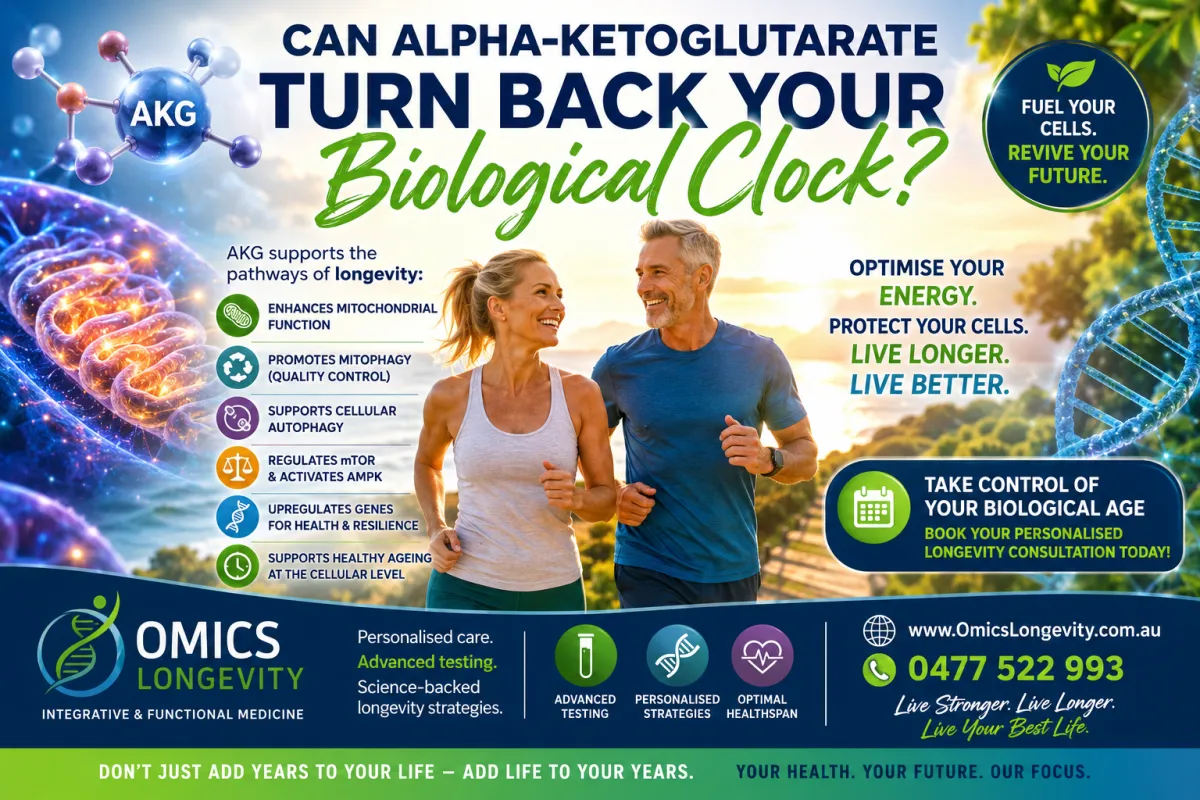
Can Alpha-Ketoglutarate Actually Turn Back Your Biological Clock?
Can Alpha-Ketoglutarate Actually Turn Back Your
Biological Clock?
Can a Natural Metabolite Really Make You Biologically Younger?
What if one of the molecules already circulating through your cells could influence some of the biological
pathways associated with ageing?
Alpha-ketoglutarate (AKG) has become one of the most intriguing compounds in longevity science.
Unlike many compounds marketed as “anti-ageing” supplements, AKG is not foreign to the body. It is a
naturally occurring metabolite positioned at the intersection of mitochondrial energy production, amino-
acid metabolism, cellular signalling and epigenetic regulation.
Research in experimental organisms has linked AKG with improved healthspan and longevity, while a
small retrospective human study of an AKG-containing formulation reported a striking reduction in DNA-
methylation biological age. However, that does not yet prove that AKG can literally reverse human ageing.
So, what does the science actually tell us?
What Is Alpha-Ketoglutarate?
Alpha-ketoglutarate - also called α-ketoglutarate, AKG or 2-oxoglutarate - is an important intermediate
of the tricarboxylic acid (TCA or Krebs) cycle inside mitochondria.
The TCA cycle helps cells convert nutrients into usable energy.
Nutrients → TCA Cycle → AKG → mitochondrial metabolism → cellular energy & signalling
But AKG does considerably more than participate in energy production.
Research suggests it is involved in:
mitochondrial metabolism
amino-acid and protein metabolism
redox regulation
collagen biology
cellular differentiation
epigenetic regulation
DNA and histone demethylation
nutrient-sensing pathways
autophagy and cellular stress responses
This combination is precisely why AKG has attracted attention in longevity research.
1. AKG and Mitochondrial Function: Supporting the Cellular
Powerhouse
Mitochondria are much more than cellular “batteries.”
They regulate energy production, oxidative stress, apoptosis, metabolic signalling and many of the cellular
processes that determine whether a cell remains resilient or becomes dysfunctional.
AKG is produced and metabolised within the TCA cycle, making it intimately connected with mitochondrial
metabolism. It can influence mitochondrial respiration, ATP metabolism and redox balance.
This relationship becomes particularly interesting with ageing.
As mitochondrial function deteriorates, cells may experience:
↓ energy efficiency
↑ oxidative stress
↑ damaged mitochondrial components
↑ inflammatory signalling
↓ metabolic flexibility
Maintaining mitochondrial quality is therefore considered an important component of healthy ageing.
AKG may act as a metabolic signal - not simply mitochondrial fuel.
Early mechanistic studies found that AKG can interact with ATP synthase, altering cellular energy
signalling. In experimental systems, this was associated with reduced TOR signalling and increased
autophagy.
That brings us to one of the most important longevity mechanisms associated with AKG.
2. AKG, Autophagy and the Cellular Recycling System
Autophagy literally means “self-eating.”
It is a cellular recycling process through which cells identify and break down damaged proteins, organelles
and other components.
Think of autophagy as an intracellular clean-up and recycling programme:
Damaged cellular material
↓
Autophagosome
↓
Lysosome
↓
OMICS LONGEVITY | BLOG DRAFT
www.OmicsLongevity.com.au | 0477 522 993 | Page 3
Breakdown + recycling
↓
Reusable cellular building blocks
Autophagy is essential for cellular housekeeping, and impaired autophagic function is strongly connected
with biological ageing.
Experimental AKG research is particularly interesting because AKG-mediated inhibition of ATP synthase
has been associated with reduced TOR activity and increased autophagy.
3. AKG and Mitophagy: Quality Control for Your Mitochondria
Autophagy removes damaged cellular components.
Mitophagy is the specialised form of autophagy responsible for removing dysfunctional
mitochondria.
Imagine a cell containing hundreds of miniature power stations. When one becomes severely damaged,
allowing it to remain active can increase oxidative stress and disrupt cellular metabolism.
Mitophagy provides a quality-control mechanism.
Damaged mitochondrion
↓
Cellular damage signals
↓
Autophagic machinery identifies the mitochondrion
↓
Autophagosome surrounds it
↓
Lysosomal degradation
↓
Components recycled
↓
Improved mitochondrial quality control
Mitophagy pathways include regulators such as PINK1/Parkin, alongside receptor-mediated pathways
involving proteins including BNIP3 and NIX.
AKG should not be described as a proven human “mitophagy drug.” Rather, its interactions with
mitochondrial metabolism, nutrient sensing and autophagy provide a plausible biological framework
through which mitochondrial quality control may be influenced.
4. AKG, AMPK and mTOR: Two Master Longevity Pathways
Two signalling networks appear repeatedly in longevity biology:
AMPK - the Cellular Energy Sensor
AMP-activated protein kinase (AMPK) responds to cellular energy availability.
When cellular energy is relatively low, AMPK signalling helps shift metabolism away from energy-intensive
growth and toward pathways associated with energy conservation and cellular maintenance.
AMPK activation can also suppress mTOR signalling.
mTOR - the Cellular Growth Controller
Mechanistic target of rapamycin (mTOR) responds to nutrients, amino acids, insulin and growth factors.
When conditions favour growth:
Nutrients / growth signals → mTOR ↑ → protein synthesis & cellular growth ↑
But chronically excessive mTOR signalling may come at the expense of cellular housekeeping.
When mTOR activity falls appropriately:
mTOR ↓ → ULK1/autophagy signalling ↑ → cellular recycling ↑
Experimental evidence indicates AKG can inhibit ATP synthase and reduce TOR pathway activity, while
AKG-associated longevity in model organisms appears partly dependent upon AMPK and FoxO pathways.
The proposed longevity pathway therefore looks something like:
AKG
↓
Cellular energy / ATP-synthase signalling
↓
AMPK-related energy sensing ↑
↓
mTOR/TOR signalling ↓
↓
Autophagy ↑
↓
Cellular maintenance & stress resilience
↓
Potential healthy-ageing effects
This pathway is biologically fascinating - but much of the strongest mechanistic evidence remains
preclinical.
5. AKG and Gene Regulation: Where Metabolism Meets Epigenetics
Perhaps the most fascinating property of AKG is that it can connect metabolism directly with gene
regulation.
AKG is an essential co-substrate for a large family of α-ketoglutarate-dependent dioxygenase enzymes.
These include enzymes involved in DNA and histone modification.
Among them are:
TET enzymes - participate in DNA demethylation pathways
JmjC-domain histone demethylases - influence histone methylation and chromatin state.
Because chromatin structure and DNA methylation influence whether particular genes are more or less
accessible for transcription, changing AKG availability can potentially affect patterns of gene expression.
Reviews of AKG biology therefore identify epigenetic regulation as one of its most compelling potential
anti-ageing mechanisms.
AKG → dioxygenase activity → epigenetic regulation → altered gene expression
Importantly, it would be misleading to say AKG simply “switches on longevity genes.”
The biology is much more complex.
AKG availability interacts with metabolites such as succinate and fumarate, oxygen availability, iron-
dependent enzymes and the existing epigenetic state of the cell.
What matters may therefore be the metabolic environment surrounding the genome, rather than AKG
concentration alone.
6. Could AKG Actually Turn Back Your Biological Clock?
This is where the headlines become particularly interesting - and where scientific caution becomes
essential.
A 2021 retrospective study evaluated 42 people taking a commercially available formulation containing
calcium alpha-ketoglutarate (CaAKG) plus sex-specific vitamins.
After an average of approximately seven months, researchers reported an average 7.96-year reduction in
DNA-methylation biological age measured using the TruMe/TruAge test.
That result understandably attracted enormous attention.
But there is a major caveat.
The study was:
small
retrospective
not a blinded placebo-controlled trial
based on an AKG-containing formulation rather than isolated AKG alone
reliant on an epigenetic-age biomarker rather than clinical ageing outcomes.
The authors themselves stated that further testing, particularly using a placebo-controlled design, was
required.
A randomized, double-blind, placebo-controlled study of the Rejuvant formulation has also been registered
to examine biomarkers including inflammation and DNA-methylation biological age.
Therefore, the responsible conclusion is:
AKG has not yet been proven to reverse human ageing by eight years.
What researchers observed was a change in an epigenetic biomarker associated with biological age.
That distinction matters.
Biological Age Is Not the Same as Chronological Age
Your chronological age is simple:
How many years have passed since you were born?
Your biological age attempts to estimate how rapidly different aspects of your body are ageing.
Researchers can assess biological ageing using measures including:
DNA methylation / epigenetic clocks
Inflammatory biomarkers
Metabolic health
Cardiovascular function
Body composition
Physical performance
Mitochondrial and metabolic biomarkers
A younger epigenetic age is potentially encouraging, but we still need long-term evidence showing that
changing a particular ageing clock translates into fewer age-related diseases, better function or longer life.
7. AKG May Mimic Some Features of Calorie Restriction
Calorie restriction has repeatedly extended lifespan in experimental organisms.
One reason may be that nutrient scarcity activates cellular survival programmes rather than continuous
growth signalling.
These include:
AMPK ↑
mTOR ↓
Autophagy ↑
Stress resistance ↑
Metabolic adaptation ↑
OMICS LONGEVITY | BLOG DRAFT
www.OmicsLongevity.com.au | 0477 522 993 | Page 7
AKG has therefore been proposed as a potential calorie-restriction mimetic or hormetic metabolic signal
rather than simply another antioxidant supplement.
That does not mean swallowing AKG reproduces fasting or calorie restriction in humans.
It means that some of the pathways influenced by AKG overlap with pathways activated during nutrient
scarcity.
8. AKG and Oxidative Stress: More Complicated Than “Antioxidant”
Oxidative stress is frequently portrayed as something that should simply be eliminated.
Longevity biology is considerably more nuanced.
AKG participates in redox metabolism and may help reduce damaging oxidative processes under certain
circumstances. But mitochondrial AKG metabolism can also influence reactive oxygen species.
Small, transient increases in ROS can actually activate adaptive cellular defence mechanisms - a
phenomenon known as mitohormesis.
The potential longevity model therefore looks more like:
Mild metabolic stress
↓
Adaptive cellular signalling
↓
Antioxidant/stress-response pathways
↓
Greater cellular resilience
rather than simply:
AKG → eliminates free radicals
Reviews of AKG and ageing specifically discuss this hormetic mechanism as one possible explanation for
some experimental longevity effects.
Putting the AKG Longevity Network Together
AKG appears to sit at the centre of several interconnected ageing pathways:
AKG
↓↙ ↘
Mitochondrial metabolism
AMPK / mTOR signalling
Epigenetic enzymes
↓
OMICS LONGEVITY | BLOG DRAFT
www.OmicsLongevity.com.au | 0477 522 993 | Page 8
Autophagy
↓
Mitophagy & cellular quality control
↓
DNA/histone regulation
↓
Stress resilience + metabolic homeostasis
↓
Potential improvement in healthspan
This interconnected biology is why AKG is considerably more interesting than a conventional “anti-ageing
supplement.”
It is fundamentally a metabolic signalling molecule.
Does AKG Extend Lifespan?
There is compelling preclinical evidence.
AKG has been associated with lifespan or healthspan improvements across several experimental
organisms, including worms and mice. Reviews of the literature describe effects involving TOR/mTOR,
ATP synthase, epigenetic regulation, redox biology and cellular stress resistance.
But there is an important gap:
We do not yet have evidence that AKG supplementation extends human lifespan.
That would require much larger and substantially longer clinical studies.
The most appropriate description today is therefore:
Promising longevity metabolite? - Yes.
Mechanistically fascinating? - Absolutely.
Proven to reverse human ageing? - Not yet.
Should Everyone Take AKG?
Not necessarily.
Longevity medicine should not simply become a collection of supplements taken because each one
influences an interesting pathway.
The same pathways that longevity interventions target - AMPK, mTOR, autophagy, mitochondrial
metabolism and epigenetic regulation - are fundamental biological systems.
The goal should therefore be appropriate optimisation rather than indiscriminate pathway suppression or
activation.
Individual factors such as medications, medical history, nutritional status, metabolic health, kidney function,
cancer history and other therapies may influence whether a particular intervention is appropriate.
Why Work With a Qualified Integrative & Functional Medicine Doctor?
A sophisticated longevity programme looks beyond a single supplement.
A qualified integrative and functional medicine doctor can assess AKG within the broader context of
your:
metabolic health
mitochondrial function
inflammation
nutritional status
cardiovascular risk
hormones
body composition
sleep and exercise
medications and supplements
biological-age biomarkers.
This is particularly important when combining AKG with other interventions targeting pathways such as
AMPK, mTOR, NAD+, autophagy or mitochondrial function.
Rather than asking:
“What anti-ageing supplement should I take?”
a better question may be:
“Which biological ageing pathways actually need attention in me?”
That is the principle behind personalised longevity medicine.
The Bottom Line: Can AKG Turn Back Your Biological Clock?
Alpha-ketoglutarate is one of the more scientifically interesting metabolites being investigated in longevity
research.
Its potential relevance reaches far beyond mitochondrial energy production.
AKG sits at the intersection of:
Mitochondrial metabolism
Autophagy
Mitophagy and mitochondrial quality control
mTOR signalling
AMPK-related metabolic signalling
DNA and histone regulation
Cellular stress resilience
Epigenetic ageing
A small human retrospective study reported an impressive reduction in measured DNA-methylation age
after supplementation with an AKG-containing formulation. But this finding should be viewed as an
intriguing early signal - not proof that AKG reverses human ageing.
The next generation of controlled human trials will help determine whether AKG's impressive molecular
biology translates into meaningful improvements in human healthspan, disease risk and longevity.
Take a More Personalised Approach to Longevity
At Omics Longevity, longevity medicine is about understanding the biology behind ageing - not simply
chasing the latest supplement.
A personalised integrative and functional medicine assessment can help evaluate metabolic health,
mitochondrial function, lifestyle factors and relevant biomarkers before deciding whether interventions such
as AKG belong in an individual longevity strategy.
Ready to explore your biological ageing and longevity strategy?
Omics Longevity - Integrative & Functional Medicine
Website: www.OmicsLongevity.com.au
Phone: 0477 522 993
https://omicslongevity.com.au/booking-form
Book a consultation to develop a personalised, medically supervised longevity strategy.
Medical disclaimer: This article is for general educational purposes only and is not medical advice.
Evidence for AKG as a human longevity intervention remains emerging. Supplements and longevity
interventions should be considered in the context of individual medical history, medications and clinical
circumstances under appropriately qualified healthcare supervision.