Bismuth Thiol and LL-37
Bismuth Thiol and LL-37: The Hidden Biofilm Busters in SIBO and Gut Healing
How Targeting Biofilms May Improve Outcomes in Small Intestinal Bacterial Overgrowth (SIBO)
Bismuth Thiol, LL-37 peptide, SIBO treatment, gut biofilms, biofilm disruptors, hydrogen sulphide SIBO, functional gut disorders, leaky gut, integrative medicine, functional medicine, Omics Longevity
Introduction
Biofilms are increasingly recognised as one of the major reasons why Small Intestinal Bacterial Overgrowth (SIBO) can be so difficult to eradicate. Patients often experience temporary improvement after antibiotics or herbal antimicrobials, only to relapse weeks or months later.
One explanation is that bacteria hide within biofilms—complex protective communities that shield microbes from antibiotics, herbs and even the immune system.
Among the most promising emerging strategies are two surprisingly different agents:
Bismuth Thiol complexes
LL-37, the body's own antimicrobial peptide
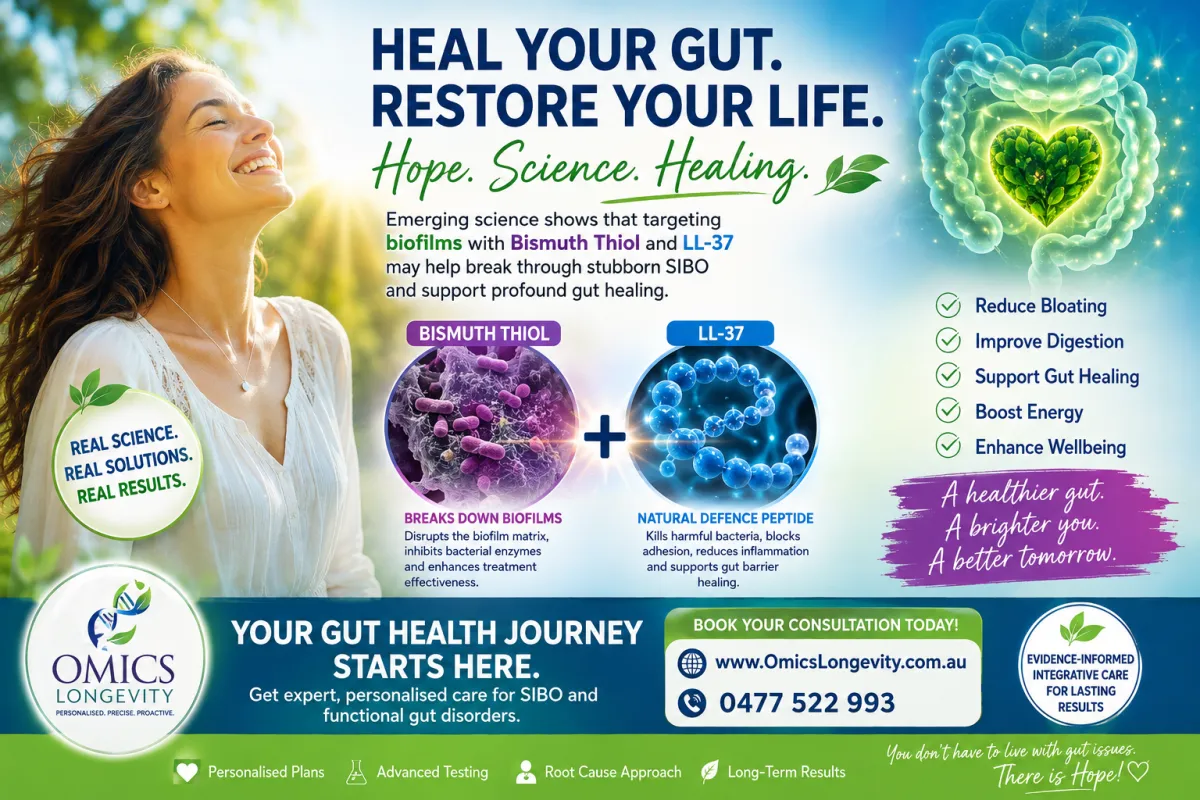
Although these therapies remain adjunctive and investigational for SIBO, they represent exciting developments in functional gastroenterology because they target the biofilm itself, rather than simply killing free-floating bacteria.
What Is a Biofilm?


A biofilm is a highly organised bacterial community enclosed within a sticky extracellular matrix made from:
Polysaccharides
Proteins
Extracellular DNA
Lipids
Metal ions
Think of it as a microscopic fortress.
Inside this fortress, bacteria can:
Hide from antibiotics
Avoid immune attack
Exchange resistance genes
Slow their metabolism
Become hundreds to thousands of times harder to eliminate
These biofilms are thought to contribute to:
Recurrent SIBO
IBS
Chronic bloating
Persistent dysbiosis
Leaky gut
Chronic inflammation
Why Standard SIBO Therapy Sometimes Fails
Many antimicrobial therapies effectively kill bacteria that are actively growing.
Unfortunately:
✔ Biofilm bacteria grow slowly
✔ Antibiotics penetrate poorly
✔ Immune cells cannot easily reach them
✔ Dormant bacteria survive treatment
Once treatment stops, surviving bacteria can recolonise the intestine.
This helps explain why many patients require repeated antibiotic courses.
Bismuth Thiol: One of the Most Powerful Biofilm Disruptors


Bismuth has been used for decades in gastroenterology.
However, bismuth-thiol complexes appear significantly more potent than traditional bismuth salts against bacterial biofilms in laboratory studies.
Mechanisms of Action
1. Disrupts the Biofilm Matrix
Bismuth interferes with the extracellular polymeric substance (EPS), weakening the structural integrity of mature biofilms and making embedded bacteria more accessible to antimicrobials.
2. Binds Sulfur-Containing Enzymes
Many bacterial enzymes rely on thiol (-SH) groups.
Bismuth binds these sulfhydryl groups, inhibiting:
Energy metabolism
Enzyme activity
DNA replication
Cellular repair
This creates significant metabolic stress for bacteria.
3. Reduces Bacterial Adhesion
Bacteria must first attach to surfaces before mature biofilms form.
Bismuth reduces bacterial adherence, limiting new biofilm development.
4. Enhances Antibiotic Penetration
Once the biofilm matrix becomes disrupted:
antibiotics
herbal antimicrobials
immune cells
may gain improved access to previously protected bacteria. This synergy is well documented in Helicobacter pyloritherapy and has prompted interest in broader biofilm-associated infections.
5. Hydrogen Sulfide Binding
Certain forms of bismuth can bind hydrogen sulfide, which has led to clinical interest in hydrogen sulfide-predominant SIBO, although high-quality clinical evidence remains limited. Careful medical supervision is important because not all bismuth formulations are equivalent.
LL-37: The Body's Natural Biofilm Fighter


LL-37 is a naturally occurring human antimicrobial peptide produced from the precursor protein hCAP-18.
Major sources include:
Neutrophils
Macrophages
Paneth cells
Intestinal epithelial cells
Skin
It forms part of our innate immune defence.
Unlike antibiotics, LL-37 does far more than simply kill bacteria.
How LL-37 Works
Direct Membrane Disruption
LL-37 carries a positive charge.
Bacterial membranes are negatively charged.
This allows LL-37 to bind bacterial membranes and disrupt them, leading to leakage of cellular contents and bacterial death.
Inhibits Bacterial Adhesion
LL-37 prevents bacteria from attaching to surfaces.
Without adhesion:
biofilms struggle to establish
colonisation is reduced
infection persistence decreases
Suppresses Quorum Sensing
One of the most fascinating properties of LL-37 is its ability to interfere with bacterial communication.
Bacteria use quorum sensing molecules to coordinate:
virulence
toxin production
biofilm formation
LL-37 downregulates these signalling pathways, preventing organised biofilm development.
Downregulates Biofilm Genes
Laboratory studies show LL-37 can reduce the expression of genes involved in:
extracellular matrix production
adhesion proteins
biofilm maturation
This makes biofilms less stable and easier to eradicate.
Immunomodulation
LL-37 also helps regulate inflammation by:
recruiting immune cells
enhancing wound healing
promoting epithelial repair
supporting mucosal immunity
This dual antimicrobial and immunomodulatory role makes it particularly interesting in intestinal disease research.
LL-37 and Gut Barrier Healing
Beyond antimicrobial effects, LL-37 appears to support:
epithelial regeneration
tight junction integrity
mucosal defence
balanced interactions between the microbiome and the immune system
These properties suggest it may have potential beyond microbial control, although clinical use in SIBO remains investigational.
Potential Synergy
One theoretical strategy under investigation is combining:
✅ Biofilm disruption (Bismuth Thiol)
↓
Exposure of hidden bacteria
↓
LL-37 antimicrobial activity
↓
Standard antimicrobials or antibiotics
↓
Microbiome restoration
↓
Motility optimisation
↓
Long-term relapse prevention
At present, this approach is based largely on mechanistic and preclinical evidence rather than large clinical trials specifically in SIBO.
Comprehensive Gut Healing Requires More Than Antimicrobials
Long-term success usually depends on identifying and addressing the factors that allowed SIBO to develop, such as:
Impaired migrating motor complex (MMC)
Slow intestinal transit
Low stomach acid
Bile insufficiency
Pancreatic enzyme deficiency
Adhesions after surgery
Nutritional deficiencies
Chronic stress
Underlying inflammatory bowel disease
Thyroid dysfunction
An individualised treatment plan often combines antimicrobial strategies with motility support, nutritional optimisation, and restoration of the intestinal barrier.
Why Work With an Integrative and Functional Medicine Doctor?
Because SIBO is rarely caused by a single factor, a comprehensive assessment is essential.
A qualified integrative and functional medicine doctor who specialises in SIBO and functional gut disorders can help:
Determine the underlying drivers of SIBO
Interpret breath testing and other investigations
Develop personalised treatment plans
Monitor the appropriate use of antibiotics, herbal therapies, peptides, or adjunctive treatments where clinically indicated
Support gut barrier repair and microbiome recovery
Reduce the risk of recurrence through long-term management
This personalised approach aims not only to improve symptoms but also to address the mechanisms contributing to chronic gut dysfunction.
Key Takeaways
Therapy Primary Actions Bismuth Thiol Biofilm disruption, enzyme inhibition, reduced adhesion, enhanced antimicrobial penetration. LL-37: direct antimicrobial peptide, inhibits bacterial adhesion, suppresses quorum sensing, downregulates biofilm genes, supports mucosal immunity and epithelial repair
While these therapies are promising, especially from mechanistic and laboratory research, larger human clinical studies are still needed to define their role in routine SIBO management.
About Omics Longevity
At Omics Longevity, we take an evidence-informed, personalised approach to complex gastrointestinal disorders, including SIBO, IBS, intestinal permeability ("leaky gut"), microbiome imbalance, and other functional gut conditions.
Our assessments integrate clinical history with appropriate testing to identify the underlying contributors to persistent digestive symptoms and develop tailored management plans.
Omics Longevity
🌐www.OmicsLongevity.com.au
📞0477 522 993
Book a consultation today to explore a personalised approach to restoring gut health and supporting long-term digestive wellness.